FOUNDATIONALCLASSICAL FOUNDATIONS
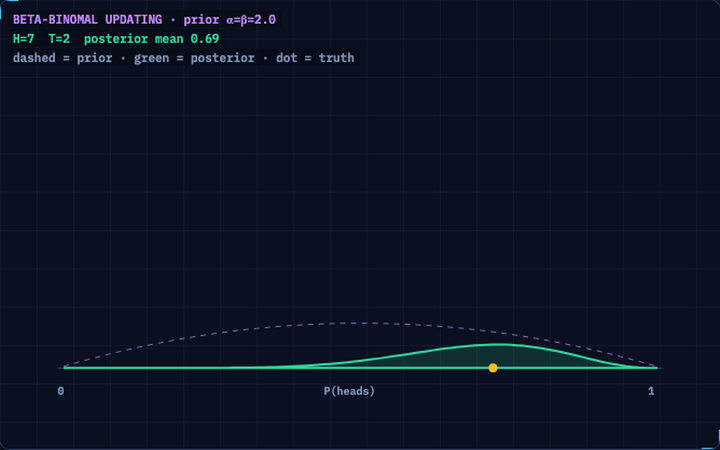
Bayes Theorem
P(H∣E) = P(E∣H) · P(H)P(E)
How belief must update when evidence arrives. The prior walks in, the data speaks, the posterior walks out.
01
SOLVEDCLASSICAL FOUNDATIONS
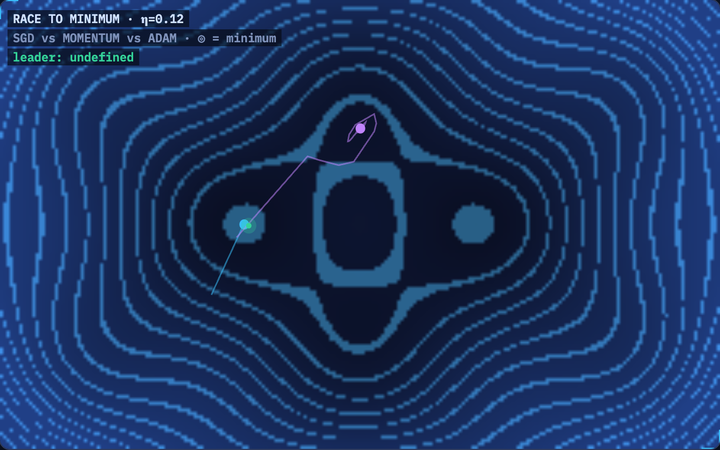
Gradient Descent
θt+1 ← θt − η ∇θ ℒ(θt)
Walk downhill on the loss surface, one small step at a time. Oldest trick in optimization — still the engine of every deep net.
02
SOLVEDCLASSICAL FOUNDATIONS
Logistic Regression
p = 11 + e−(w·x + b)
Squash any score into a probability with the sigmoid. The humble baseline that beats deep nets more often than anyone admits.
03
SOLVEDCLASSICAL FOUNDATIONS
Support Vector Machine
minw,b ½‖w‖² + C Σ max(0, 1 − yi(w·xi+b))
Not just any separator — the one with the widest margin. The hinge loss only charges points that get too close.
04
SOLVEDCLASSICAL FOUNDATIONS
K-Means
argminS Σi=1k Σx∈Si ‖x − μi‖²
Assign every point to its nearest centroid, move centroids to the mean, repeat. The ping-pong that finds clusters.
05
SOLVEDCLASSICAL FOUNDATIONS
Decision Trees · CART
Gini(S) = 1 − Σc pc²
Ask the single question that purifies the data most, then ask again. Greedy axis-aligned splits, scored by impurity.
06
IN-USECLASSICAL FOUNDATIONS
Random Forests
f̂(x) = 1B Σb=1B Tb(x)
A parliament of noisy trees, each trained on a bootstrap sample, votes away individual stupidity. Bagging works.
07
SOLVEDCLASSICAL FOUNDATIONS
Principal Component Analysis
w* = argmax‖w‖=1 wT Σ w
Find the direction the data stretches along most, project onto it, keep the variance, discard the noise.
08
SOLVEDTHE DEEP LEARNING CORE
Backpropagation
∂ℒ∂W(ℓ) = δ(ℓ) (a(ℓ−1))T
The chain rule, industrialized. Error flows backward layer by layer, telling every weight exactly how much it is to blame.
09
IN-USETHE DEEP LEARNING CORE
Softmax
softmax(z)i = eziΣj ezj
Turn a vector of scores into a probability distribution. Temperature decides whether it whispers or shouts.
10
IN-USETHE DEEP LEARNING CORE
Adam Optimizer
θ ← θ − η m̂t√v̂t + ε
Momentum plus per-parameter learning rates, bias-corrected. The default engine of the deep learning era.
11
FOUNDATIONALTHE DEEP LEARNING CORE
Convolution
(I ∗ K)i,j = ΣmΣn Ii−m, j−n · Km,n
Slide a small kernel across a signal; multiply, sum, repeat. Two centuries old — and still how machines see.
12
IN-USETHE DEEP LEARNING CORE
Scaled Dot-Product Attention
Attention(Q,K,V) = softmaxQKT√dk V
Every token asks every other token: how relevant are you to me? — then reads a weighted blend of their values. The heart of every LLM.
13
IN-USEGENERATIVE MODELS
Generative Adversarial Networks
minG maxD 𝔼x[log D(x)] + 𝔼z[log(1 − D(G(z)))]
A forger and a detective locked in a zero-sum game. The forger gets good because the detective keeps score.
14
IN-USEGENERATIVE MODELS
Variational Autoencoder
ℒ = 𝔼q(z∣x)[log p(x∣z)] − β · DKL(q(z∣x) ‖ 𝒩(0,I))
Encode into a probability cloud, decode from anywhere inside it. Reconstruction quality versus latent smoothness — one dial, β.
15
IN-USEGENERATIVE MODELS
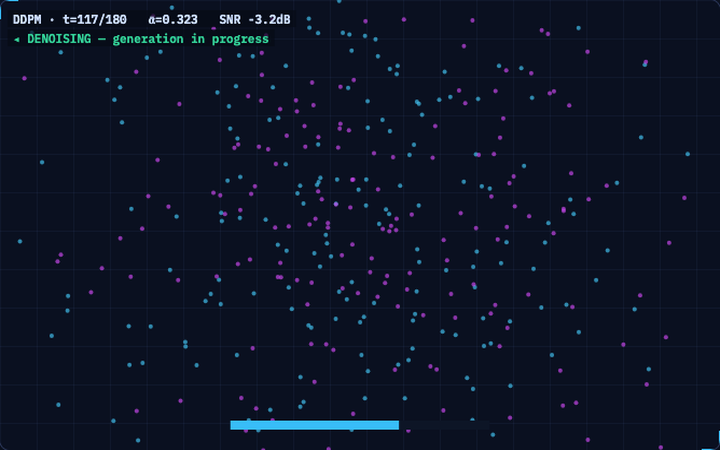
Denoising Diffusion · DDPM
q(xt∣x0) = 𝒩(√ᾱt x0, (1−ᾱt)I)
Destroy data with noise, then train a net to undo it one whisper at a time. Generation is just denoising from pure static.
16
IN-USEGENERATIVE MODELS
Flow Matching
d xtd t = vθ(xt, t)
Learn the velocity field that carries noise to data — and straighten the roads while you are at it. The faster, cleaner cousin of diffusion.
17
SOLVEDREINFORCEMENT LEARNING
Q-Learning · Bellman Update
Q(s,a) ← Q(s,a) + α[ r + γ maxa′ Q(s′,a′) − Q(s,a) ]
Bootstrapping value from value: each step teaches the current guess using the best guess next door. Off-policy, model-free, provably convergent.
18
IN-USEREINFORCEMENT LEARNING
Proximal Policy Optimization
ℒ = 𝔼t[ min( rt Ât, clip(rt, 1−ε, 1+ε) Ât )]
Improve the policy, but clip how far any single update may wander. The workhorse behind RLHF and aligned chat models.
19
IN-USETHE 2020s FRONTIER
Contrastive Learning · InfoNCE / CLIP
ℒ = −log exp(sim(zi, zj)/τ)Σk exp(sim(zi, zk)/τ)
Push matching pairs together, shove everything else apart. 400 million image–text pairs taught embeddings to understand language.
20
EXPERIMENTALTHE 2020s FRONTIER
KAN — Kolmogorov–Arnold Networks
f(x) = Σq Φq( Σp φq,p(xp) )
Fire the fixed activations: put learnable univariate functions on the edges instead. Promising, contested, very 2024.
21
EMERGINGTHE 2020s FRONTIER
Mixture of Experts
y = Σi G(x)i · Ei(x), G = softmax(Wgx)
A router picks the few experts each token needs. Billions of parameters exist — only a fraction ever fire at once.
22
EMERGINGTHE 2020s FRONTIER
Mamba · Selective State Spaces
ht = Āt ht−1 + B̄t xt, yt = Ct ht
A recurrent scan that chooses what to remember and what to forget, per token — the O(n) challenger to attention.
23
IN-USETHE 2020s FRONTIER
LoRA — Low-Rank Adaptation
W = W0 + ΔW = W0 + BA, B∈ℝd×r, r ≪ d
Freeze the giant. Train two skinny matrices whose product nudges it. Fine-tuning went from impossible to laptop-sized.
24